Artificial Intelligence
A general explanation of artificial intelligence, machine learning, and artificial neural networks.
Artificial Intelligence (AI) is a field of computer science that aims to develop algorithms capable of performing tasks that would previously have been carried out by humans.
But what is an algorithm?
An algorithm is essentially a set of rules to follow when solving a problem.
AI can be used to make decisions and solve problems autonomously, without human intervention in the process.
However, artificial intelligence can easily be confused with other fields. In this post, we will understand the similarities and differences between topics related to AI, such as Machine Learning, Artificial Neural Networks, and Deep Learning.
Machine learning
Machine Learning (ML) is a subfield of artificial intelligence in which algorithms are built and then fed data. They use that data to learn a particular task without human intervention in the learning process.
Essentially, machine learning is one of several approaches within artificial intelligence for creating autonomous algorithms that can learn and adapt to different variables.
Artificial neural networks
An Artificial Neural Network (ANN) is a type of machine learning model that simulates the behavior and functioning of the human brain.
An ANN can tackle complex problems using processing units called neurons, which receive inputs and produce an output.
What is a biological neuron?
Biological neurons are cells that respond to stimuli in their environment through changes in the electrical potential across their cell membranes. These changes propagate to other neurons, muscles, and glands. Neurons therefore play an essential role in the functioning, behavior, and reasoning of living organisms.
An artificial neuron is a logical-mathematical structure intended to simulate the behavior and functioning of a biological neuron by processing multiple inputs and providing outputs. These neurons are connected and organized in layers to form a network, where inputs are supplied to the input layer and outputs are obtained from the output layer, so the network can be trained to recognize patterns in data.
The basic idea of an ANN is to process information using a structure inspired by the organization of neurons in the brain. However, an ANN has far fewer neurons than a human brain, which contains billions of neurons.
A synapse is a connection between neurons. Values assigned to these connections are called synaptic weights; they determine the strength of each connection. Each neuron processes information independently and in parallel with other neurons, passing its result on through the connections.
Training an ANN involves adjusting the connections' synaptic weights to improve the model's performance. This helps the model learn to map inputs to outputs while minimizing the difference between predicted and actual outputs.
The figure below shows the architecture of an artificial neural network with one input layer, two hidden/intermediate layers, and one output layer. In this configuration, each neuron is connected to all the neurons in adjacent layers in one-way communication (neurons in the same layer do not communicate). Common neural networks use an architecture called feedforward, in which information flows in one direction without cycles. Stimuli or signals enter through the input layer and propagate forward without any change.
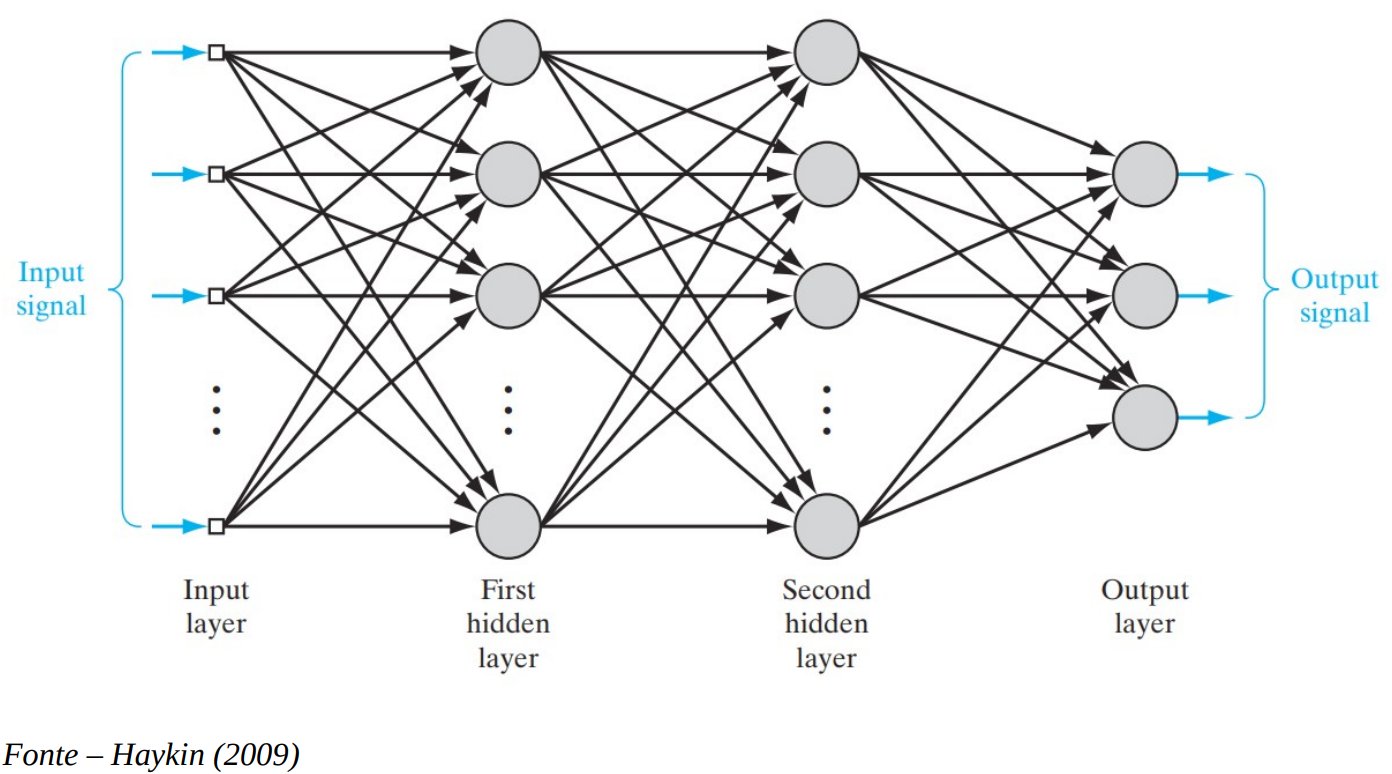
Input signals arrive at the network's input layer and propagate from neuron to neuron until they reach the output layer, producing output signals.
The data to be processed is passed to neurons in the input layer. Input values are multiplied by their respective weights and passed to neurons in the next connected layer. Neural networks are generally organized in layers of one or more neurons. Neuron outputs are combined using an activation function and used as inputs to the next layer.
An ANN's performance in solving a problem is determined by its architecture, which specifies the number of neurons, how they are connected, the weights of the connections, and the number of layers.
An artificial neural network can be used to solve a problem in three main phases:
-
Training: The model learns from input patterns, attempts to solve the problem, and produces output patterns.
-
Testing: Input patterns are presented to the model, and its outputs are compared with the desired outputs.
-
Application: The model is used to solve a particular problem.
Like the human brain, ANNs can interact with and adapt to their environment. They are used in fields such as engineering, economics, agriculture, and medicine for tasks including classification, categorization, estimation, and forecasting.
Deep learning
Deep Learning (DL) is a subfield of machine learning based on artificial neural networks with more than one hidden layer (also called an intermediate layer).
Author
Mathias Artur Schulz
Senior Software Engineer
Bachelor's degree in Computer Science and Postgraduate degree in Software Engineering
Email:mathias@schulz.net.br